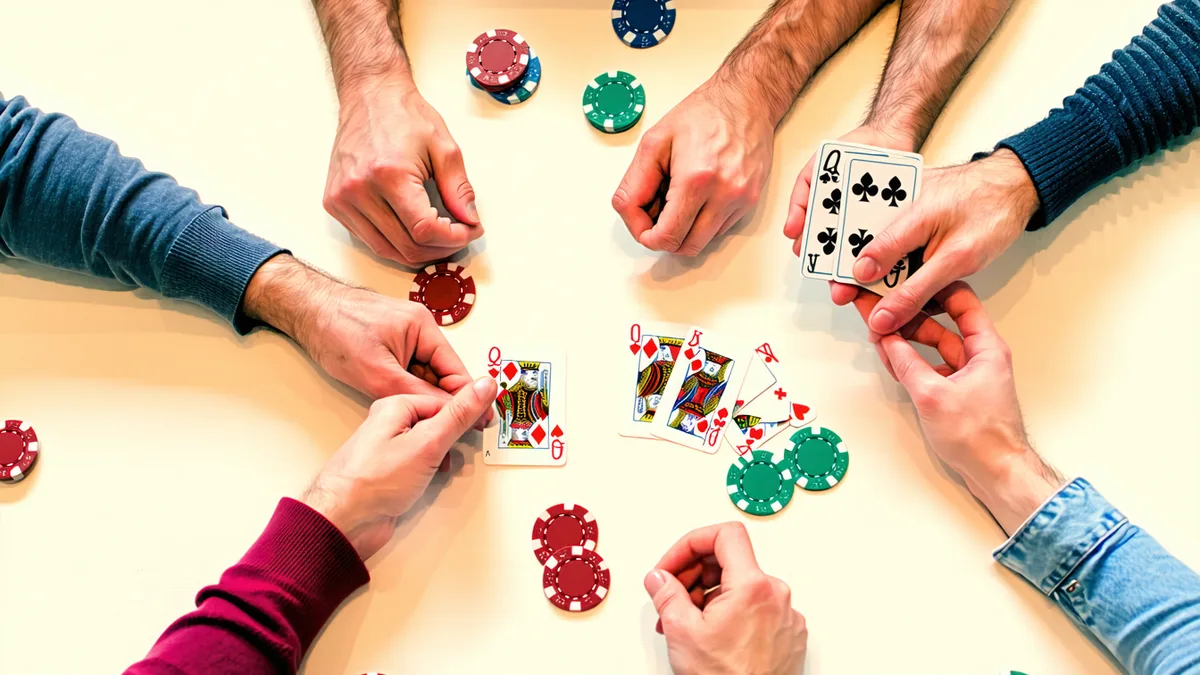
Texas Hold'em has a reputation for complexity that its basic rules don't quite deserve. The core of the game is simple: each player gets two cards, five community cards come out in stages, everyone tries to make the best five-card hand using any combination of their cards and the community cards, and the person with the best hand at showdown wins the pot. That's it at the highest level.
Where people get confused — and where most home game arguments come from — is the specific sequence of betting rounds, the blind structure, and what to do in edge cases like ties and side pots. This guide covers all of that in plain language. No assumed knowledge, no jargon that isn't immediately explained.
Setting up the table
You need a dealer button — a small disc that marks who is nominally "dealing" each hand. In a home game, this usually rotates clockwise around the table after each hand. The two players to the left of the dealer button post the blinds: the player immediately to the left posts the small blind, and the next player posts the big blind. These are mandatory bets placed before anyone sees their cards. In a home game, a common starting setup is 25 chips for the small blind and 50 chips for the big blind.
Each player starts with a stack of chips. For a casual two-hour game among friends, 1,000 chips per person with a 25/50 starting blind structure gives everyone about 20 big blinds, which is comfortable for casual play without hands ending too quickly. If you want a longer game, give everyone 1,500 or 2,000 chips.
The four betting rounds
A hand of Texas Hold'em has four distinct rounds, each with a round of betting.
Pre-flop: Everyone gets two hole cards face-down. Betting starts with the player to the left of the big blind (called "under the gun") and goes clockwise. Each player can call the big blind amount, raise, or fold. The small blind and big blind act last in this round; the big blind gets the option to raise even if no one else did.
The flop: Three community cards are dealt face-up in the center of the table. Betting now starts with the first active player to the left of the dealer button and continues clockwise. Players can check (pass without betting), bet, call, raise, or fold.
The turn: A fourth community card is dealt. Another round of betting with the same structure.
The river: The fifth and final community card is dealt. Final round of betting. If more than one player remains after the betting is complete, there's a showdown — players reveal their hole cards, and the best five-card hand wins the pot.
Hand rankings, from best to worst
You make your best five-card hand using any combination of your two hole cards and the five community cards on the board — meaning you can use both hole cards, one hole card, or neither (if the board alone makes a better hand). Here are the hands from strongest to weakest:
- Royal Flush: A, K, Q, J, 10 all in the same suit. Rarest hand, almost never seen in a casual game.
- Straight Flush: Five consecutive cards in the same suit (e.g., 6-7-8-9-10 of hearts).
- Four of a Kind: Four cards of the same rank (e.g., four kings).
- Full House: Three of a kind plus a pair (e.g., three aces and two sevens).
- Flush: Five cards in the same suit, not consecutive.
- Straight: Five consecutive cards, any suits (e.g., 5-6-7-8-9).
- Three of a Kind: Three cards of the same rank.
- Two Pair: Two different pairs (e.g., a pair of kings and a pair of fours).
- One Pair: Two cards of the same rank.
- High Card: No matching hands — your highest card plays.
Ties are broken by the highest card in the hand (the "kicker"). If two players both have a pair of queens, the player with the higher second card — the kicker — wins. If everything ties exactly, the pot is split.
Blind levels and when to raise them
For a casual home game, you don't need a sophisticated blind structure. A simple approach: start at 25/50, and increase the blinds every 20–25 minutes. Going from 25/50 to 50/100 to 100/200 over an hour and a half naturally pressures shorter stacks to play hands and keeps the game moving toward a conclusion.
For a group that just wants to play casually for an evening without anyone being eliminated, you can keep blinds flat the entire time and just play until you feel like stopping. Fixed blinds are slower to create chip leader pressure, but for friends who are there for the social experience more than the competition, that's often fine.
One thing to decide before the game starts: rebuys. If a player loses all their chips, can they buy back in? For casual social games, allowing one rebuy per person at the same starting stack keeps everyone at the table longer, which is usually what a friendly group wants. Decide on this in advance so there's no argument when someone busts out in the first thirty minutes.
The all-in and side pot rules (only if needed)
At some point, someone will go all-in with fewer chips than another player's bet. This creates a side pot. The all-in player is only eligible to win the main pot — the amount they actually matched. Excess chips from larger stacks go into a side pot that only the players who contributed to it can win.
In practice: if the pot has 400 chips and Player A goes all-in for 100, Player B calls for 100, and Player C calls for 100, Player A is eligible for the main pot of 300. If B and C keep betting into a side pot, that side pot is only contested between them. A can win the main pot regardless of what happens between B and C.
For casual home games, the rule of thumb is: always put all-in chips clearly separated from the other bets, and figure out the side pot at showdown rather than trying to track it mentally through the betting round.
Basic table etiquette for new players
A few habits that keep the game moving and keep everyone happy:
- Act in turn. Don't fold, call, or raise until it's your turn. Acting out of turn gives other players unfair information about your hand.
- Announce your action. Say "call," "raise," or "fold" before you move chips. This prevents ambiguity about what you intended.
- Keep your cards visible. Don't hold them up to your face or lift them off the table — they should be face-down, slightly elevated at the edge, only visible to you.
- Don't discuss your hand while it's live. If you folded, don't tell other players what you had until the hand is completely over. It can change how active players make decisions.
- One player per hand. Don't take advice from railbirds or give advice while a hand is in progress. It's bad form and can compromise the integrity of the hand for other players.
None of these are strict rules in a casual setting — you're playing with friends, not at a casino. But following them keeps things fair and keeps the game moving at a good pace, which is what makes the evening fun for everyone at the table.
One honest note about stakes
Lipoker uses virtual chips — no real money changes hands. This makes it genuinely accessible for new players who aren't ready to worry about real-money stakes, and keeps game nights low-stakes by design. The fun of poker — reading people, making decisions under uncertainty, the swings of luck — doesn't require money on the line to be real. A good trash-talk moment over a big bluff is exactly as satisfying whether the pot is virtual chips or otherwise.
Once you know the rules, the fastest way to actually learn the game is to play it. Start with low virtual blind levels, play every hand to showdown for the first few rounds even if you wouldn't normally, and just watch what hands beat what. You'll have the structure in your head within a single session.